Blog: The UK Nuclear Sector- Symptom or Cure?

, Dalton Nuclear Institute, explores what the UK nuclear sector can tell us about the wider challenges facing government. Against the backdrop of the Government’s agenda to reduce administrative burdens and enable faster, more effective decision-making, he considers how different approaches to risk and governance, already being developed, could help unlock the nuclear sector’s potential.
Background
The Prime Minister, Andy Burnham, has a very ambitious agenda for change but, very early in his tenure, the ability of the machinery of Government to move at the necessary pace was . Earlier this month, the Chancellor, the First Secretary of State and the Attorney General to say they ‘need to shoulder the responsibility for acting’ and explicitly looking to rebalance the use of consultation, to rethink tolerance of legal risk, and to redefine the role of judicial review. These changes are described as ‘initial steps in what will be a wider programme of work to pare back counterproductive administrative burdens’ allowing Ministers to act boldly, take responsibility, and instil greater agency within their Departments.
Both the messaging and the timing are opportune for the nuclear sector, which is still digesting the , set up to address the ‘systemic regulatory failure’ which has made the UK ‘the most expensive place in the World to build nuclear…’. The NRTF reported in late 2025, making 47 recommendations, and the Dalton Nuclear Institute (DNI) developed opportunities to address these in a subsequent . It now seems possible that a new Prime Minister with an ambitious change agenda, coupled with a shift to more proportionate regulation, can enable nuclear to fulfil its potential to meet our national and energy security requirements.
Risk and the Nuclear Sector
The idea of risk seems straightforward but, in a modern society, it comes in a wide range of flavours. Add complexity in governance where different stakeholders have different agendas and priorities, and management of risk can quickly impede progress while simultaneously obscuring serious hazards and distracting from resolution.
Risk was a particular area of focus in the DNI paper. The NRTF talked about ‘Portfolio Risk’ but didn’t really explore it in detail or suggest an approach to its management. However, DNI developed the idea and suggested the UK nuclear sector comprises three distinct portfolios:
The NDA Estate - 18 Licensed Sites, tasked with delivering the NDA mission of decommissioning and cleaning up the legacy from the UK’s historic nuclear programmes.
The Defence Nuclear Enterprise - 15 Licensed Sites owned and operated by multiple organisations, including AWE, Rolls-Royce, BAE Systems, and concerned with manufacturing and operating the UK’s military nuclear capability.
Nuclear Generation - 9 Licensed Sites, all operated commercially by EDF Energy but legally owned by three different entities, either generating power or constructing new power reactors.
The critical point about Portfolio Risk is that, if we just focus on individual risks (e.g. commercial, legal, reputational….) in one part of a portfolio, we lose sight of a much bigger risk - that of the entire portfolio failing to deliver its mission, whether that is effective maintenance of the continuous at-sea deterrent, cleanup of the UK’s historical nuclear legacy, or generation of stable, low-carbon electricity.
HM Treasury’s strongly encourages exactly this reductionist approach to risk management, leading to consideration in turn of distinct classes of risk and sometimes multiple sub-classes within these, but not enabling an upwards view to appraise risks at the Portfolio or Sector level. Moreover, the Orange Book approach to risk can also lead to treatment of the different classes of risk as if they are independent, whereas they are in fact often strongly interdependent, leading to an inability to see the ‘wood for the trees’. Although risk classes may be analysed separately, interdependencies mean that the risk appetite associated with a specific piece of work will often actually be that of the most cautious element- in other words a project ‘goes at the pace of the slowest’.
The nuclear sector thus provides an excellent illustration of the difference between the Orange Book’s idealised view and the reality of a complex hierarchy of risks. At the site or operational level, accountabilities are already very clear, defined through the Nuclear Installations Act, Site Licensing and other tools, including the explicit identification of legally accountable duty holders. Above the individual duty holders, however, there is Portfolio Risk, as described above and, indeed, above that is what the DNI Paper terms ‘Sector Risk’; that is the potential for activities within one portfolio to adversely impact others. At first sight Sector Risk is not obvious, but the current mixture of risk aversion, over-complication, bureaucracy, inefficiency and poor delivery actually provides a perfect illustration. It has required drastic intervention from the highest level of Government, through the Regulatory Review and the accompanying , to address this Sector Risk.
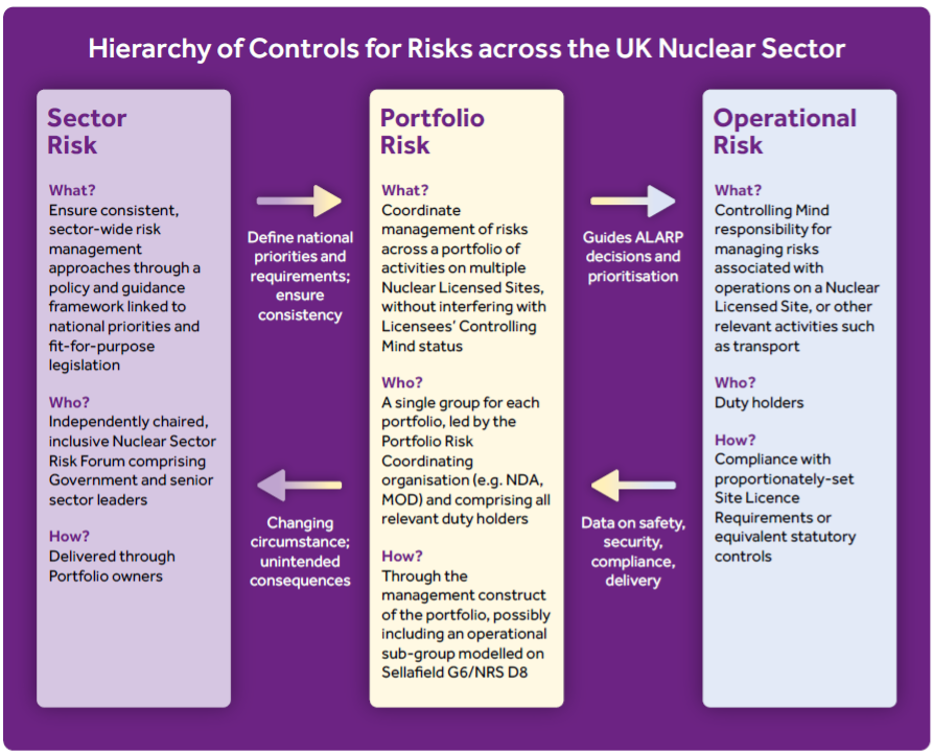
Managing a Hierarchy of Risks
We have developed a possible governance structure for the sector, illustrated in Figure 1, which integrates the management of the three levels of risk within a single coherent framework. Legal responsibility and Controlling Mind authority rest clearly with the duty holders. The responsibility of portfolio owners is to put in place management frameworks which allow coordinated risk management across their portfolio and, since they do not have Controlling Mind authority, they must do this by working collectively with the duty holders in their portfolio. Such arrangements could include an operational sub-group, modelled on the Sellafield G6 or NRS D8[1]. There is a tension between duty holders’ ‘local’ ALARP[2] approach and the wider portfolio ALARP thinking, which will need to be managed through judicious use of flexibility and judgement such that Site Licensees can use the shared understanding of risks across the portfolio to defend their local decisions and actions as ‘reasonable’. There is also a need for a consistent sector-wide approach to risk management, reflecting national priorities, which we suggest should be overseen by an independently-chaired Nuclear Sector Risk Forum.
This structure can address the weakness in the Orange Book approach to risk management by providing clearer accountabilities and relationships, and enabling decision making at the correct level in the Enterprise. Such a change of approach is both timely and necessary. The NRTF report and the DNI Paper together offer both a detailed diagnosis of the problem and a potential cure.
While this discussion is focussed on nuclear, the problems identified are not limited to that one sector - lack of accountability, inability to get things done, delay and spiralling costs are endemic across UK Government’s programmes. The changes portended by the Chancellor’s letter could, if implemented sustainably, be transformative. Here, we offer a solution, noting that the nuclear sector has already been thinking about transformative change for some time. The ingredients are there - let’s use nuclear as an exemplar for the wider changes we must implement across the UK’s complex cross sectoral infrastructure landscape.
[1] G6 (Sellafield) and D8 (Nuclear Restoration Services) are fora in which all stakeholders (Government, regulators and duty holders) convene to develop an optimised, consensus approach to difficult safety and/or environmental issues
[2] There is an overarching requirement on duty holders in the nuclear sector to reduce risks to the point they are As Low As Reasonably Practicable (ALARP)
This piece draws on the Dalton Nuclear Institute’s recent policy position paper, ‘, authored by William Bodel, Adrian Bull, Gregg Butler, Francis Livens and Fiona Rayment.