New series of papers on Automatic experimental design with expert in the loop
A recent series of papers from Professor Samuel Kaski鈥檚 research group explores how automatic experimental design can be made practical when expert knowledge, model uncertainty and uncertain goals all need to be taken into account.
These papers were the focus of two recent presentations, at the Bayesian Experimental Design workshop at on 24 June, and at the and Leverhulme Research Centre Conference on 29 June.
The series is organised around two central questions: how should we design experiments when there are unknowns in the model, and how should we proceed when there are unknowns in the goal?
For unknowns in the model, the starting point is Bayesian inference: use data to update beliefs about what is uncertain, and, where possible, choose new measurements that are expected to be most useful. Bayesian decision theory provides the framework for selecting measurement actions, or other decisions, by maximising expected utility. Bayesian optimisation can be viewed as an important instance of this broader approach.
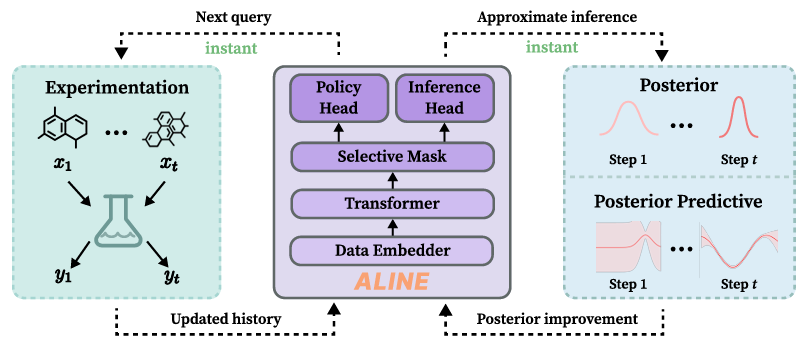
Although these ideas have been understood in principle for some time, the challenge has been computational: the calculations are often too expensive for interactive use in realistic experimental design settings. The papers in this series address that bottleneck through amortisation 鈥� an elegantly simple idea in spirit, where expensive online computation is shifted into offline pre-computation. In practice, this means learning from a large collection of simulated designs a function that maps an experimental design context or history to a strong next design choice.
Together, the papers extend this amortised approach in several directions: to multi-objective Bayesian optimisation, dimension-agnostic settings, preferential or pairwise inputs, and noisy or perturbed inputs from biased experts with partial knowledge. The result is a coherent line of work showing how expert-in-the-loop automatic experimental design can become more scalable, interactive and practically useful.
This work was undertaken by: , , , , , , , , , , Julien Martinelli, , , , , , , , , .
This work was supported by Professor Kaski's UKRI Turing AI World-Leading Researcher Fellowship [EP/W002973/1].