First isolable uranium鈥揷arbon triple bond opens new window into heavy-element chemistry
University of Manchester chemists help create the first isolable uranium鈥揷arbon triple bond, giving scientists a clearer view of how uranium shares electrons with carbon and opening new routes for fundamental actinide chemistry.
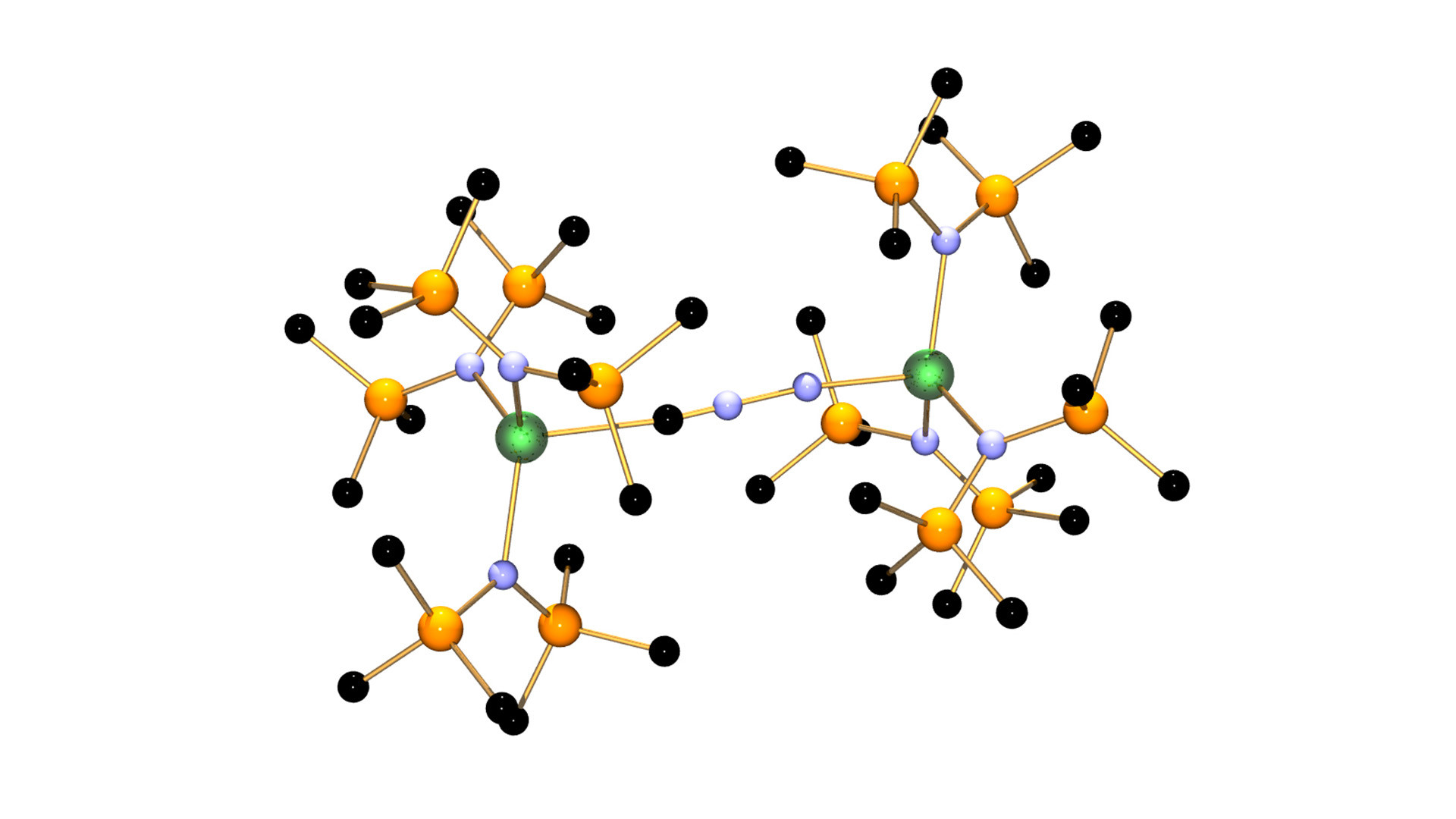
- Researchers have created the first isolable uranium鈥揷arbon triple bond, overcoming a longstanding challenge in heavy-element chemistry.
- The team used a new carbon-atom transfer strategy to make the uranium compound stable enough to isolate and study in detail.
- Advanced experimental and computational techniques confirmed the unusual bonding, revealing how uranium and carbon share electrons in a way that is related to, but distinct from, transition-metal chemistry.
- Published in Nature Chemistry, the discovery deepens understanding of uranium and actinide chemistry and opens new routes to previously inaccessible compounds.
In a study published in Nature Chemistry, an international team of researchers from Germany and the UK, including chemists from The University of Manchester, have synthesised and characterised what they describe as the first isolable uranium Fischer-type carbyne, a compound where carbon forms an unusual triple-bond interaction with uranium.
The findings give researchers a clearer example of how uranium can form multiple bonds with carbon, providing a new reference point for comparing the chemistry of actinides with more familiar transition metals. The discovery also demonstrates a new way of building previously inaccessible uranium compounds, expanding the toolkit for studying heavy-element chemistry.
Showing that uranium can form a rare carbon bond
Metal-carbon triple bonds are well established in transition-metal chemistry, but creating an equivalent uranium compound stable enough to isolate and study has proved much more challenging. Until now, related uranium examples had only been observed under highly specialised conditions, such as at extremely low temperatures or when trapped inside hollow carbon molecules known as fullerene cages.
The team, including , , , and Adam Brookfield, used a new synthetic strategy combining a uranium precursor with a recently developed carbon-atom transfer reagent, enabling them to create the compound and study it in detail.
To confirm the discovery, the researchers used single-crystal X-ray diffraction, spectroscopy, magnetometry and advanced computational analysis. Together, these methods showed that the new compound has the key features expected for a Fischer-type carbyne.
This work addresses a longstanding challenge in f-element chemistry. By isolating and studying this compound in detail, we have been able to show that uranium can support a Fischer-type carbyne interaction that is related to, but distinct from, those previously established for transition metals. The result expands our understanding of how uranium engages in multiple bonding with carbon and provides a foundation for exploring new areas of actinide chemistry.
The team鈥檚 measurements showed that the uranium and carbon atoms sit 2.379(15) 脜 apart from each other. In chemical structures, shorter distances are usually needed to have multiple bonding, but in this case quantum crystallography was used to visualise and confirm the uranium鈥揷arbon triple-bond interaction. Further analysis showed that this bond is formed through two-way electron sharing: carbon donates two electrons to uranium, while uranium also donates electrons back to carbon, in this case with two orthogonal one electron bonds which is rare.
The compound was also found to be relatively unreactive, which is what chemists would expect for this type of Fischer carbyne. Additional experiments showed that the bonding could be changed through chemical reduction, giving the team further evidence for how the compound鈥檚 electrons are arranged.
Why the discovery matters
The findings are primarily important for fundamental chemistry. They provide researchers with a clearer picture of how uranium forms bonds with carbon and help place actinide chemistry within a broader understanding of how elements behave across the periodic table.
The work also highlights the potential of modern carbon-atom transfer reagents to create compounds that were previously difficult or impossible to access, potentially enabling future studies of uranium-carbon bonding and related actinide systems.
, Research Fellow, at The University of Manchester, said: 鈥淭his study provides a platform for exploring new uranium-carbon bonding chemistry. Understanding how these interactions work will help us place actinide chemistry in a broader context and could guide future efforts to design related compounds.鈥�
This research was published in: Nature Chemistry
Full title of the paper: A Crystalline Uranium Fischer-Type Carbyne
DOI: 10.1038/s41557-026-02260-0