Electrical control of spin signals demonstrated in graphene superlattices
This research was published in the journal Nature Communications.
Spin magnetic proximity effect in graphene superlattices
- DOI:
- URL:
Researchers at the , in collaboration with the National University of Singapore, have shown that the magnetic behaviour of electrons in graphene can be precisely controlled using electricity, revealing unusually large spin signals in a carefully engineered graphene system.
The study, published in , demonstrates how placing graphene close to a magnetic material can influence the spin of electrons without permanently altering graphene itself. By combining this magnetic proximity effect with graphene superlattices and operating at very low charge densities, the researchers were able to strongly tune how spins move through the material.
鈥淭his work shows that by combining graphene with nearby magnetic materials, we can gain a high level of control over electron spin using electrical signals alone,鈥� said Dr Daniel Burrow, from The University of Manchester. 鈥淚n simple terms, we are learning how to pass information through graphene using the spin of electrons rather than their electrical charge.鈥�
Electron spin is a quantum property that can act like a tiny magnetic compass needle. While conventional electronics rely on the movement of charge, spin-based approaches aim to use this magnetic degree of freedom to process and carry information, potentially reducing energy losses.
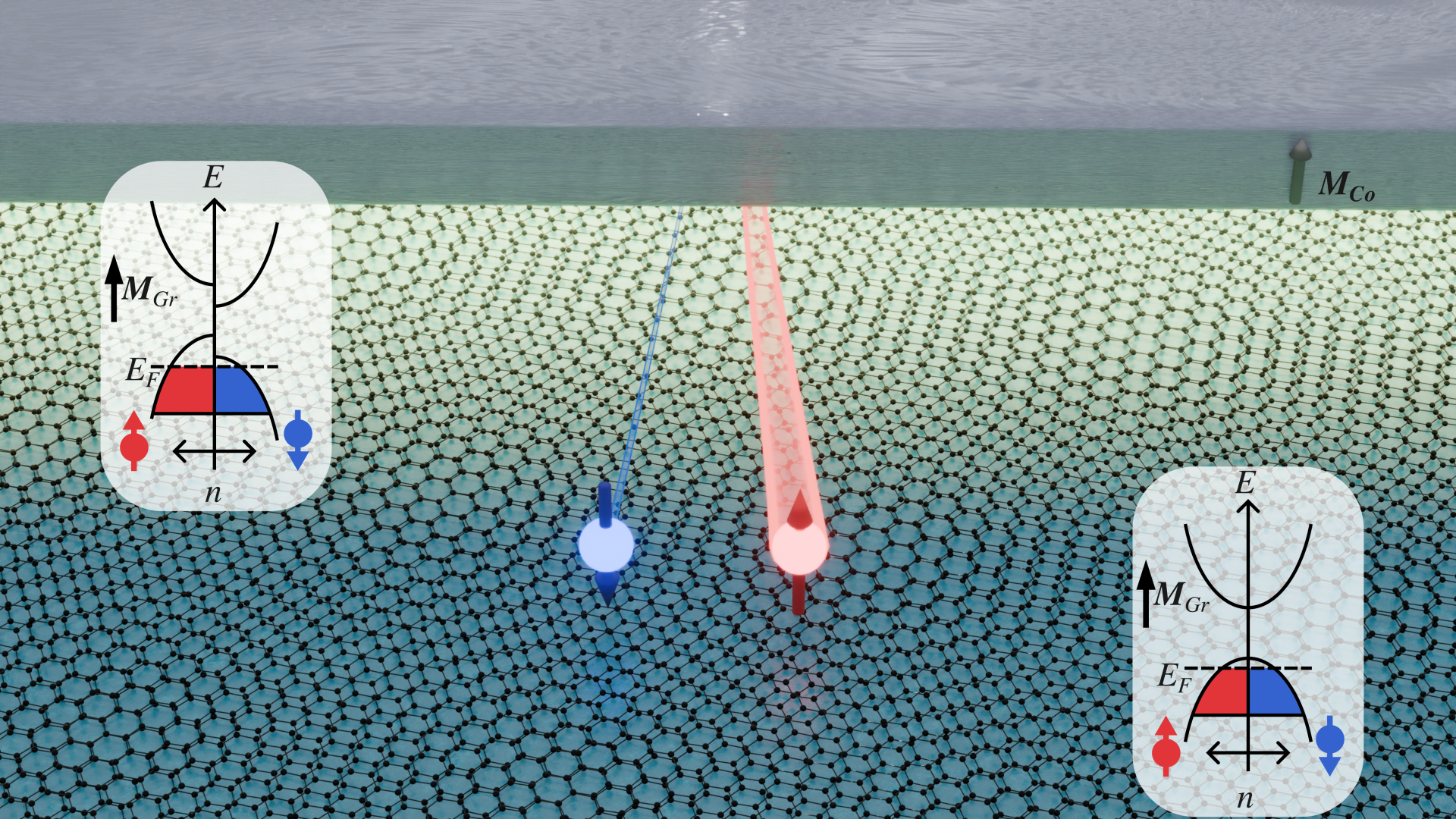
In the study, the team used cobalt contacts to induce magnetism in graphene through proximity, meaning the graphene itself does not become magnetic. They then injected and detected pure spin currents, allowing them to probe how spin transport changes across different electronic regimes.
Near the charge neutrality point, where graphene has very few mobile charge carriers, the researchers observed a clear reversal of the spin signal. This behaviour indicates that the magnetic proximity effect creates a spin dependent energy splitting in graphene, which governs how spins travel through the material.
Importantly, the same effect was also observed at additional neutrality points that appear when graphene is precisely aligned with hexagonal boron nitride. These so called superlattice features show that proximity induced spin control applies not only to graphene鈥檚 original electronic bands but also to those reconstructed by the superlattice structure.
鈥淥ur measurements show that the same underlying mechanism controls spin transport across all these regimes,鈥� said Dr Burrow. 鈥淭hat tells us we are seeing a robust physical effect rather than something specific to a single device setting.鈥�
The strongest signals were observed in a bilayer graphene superlattice device designed to open an energy gap in the electronic structure. In this specific system, the researchers measured spin polarisations approaching 50 per cent and nonlocal spin resistances exceeding 300 ohms. These values are nearly two orders of magnitude larger than those measured away from charge neutrality in the same experimental platform.
The study shows that low carrier density, combined with magnetic proximity effects and engineered band structure, can greatly enhance spin filtering and detection. While the work focuses on demonstrating the physics, the authors note that electrical control of spin at low power could be relevant for future spin based electronic technologies.
鈥淭his research shows that we can engineer graphene systems where spin signals become both large and electrically tunable,鈥� said , a co-author of the study. 鈥淭hat opens up new ways to explore spin transport in two-dimensional materials and brings us closer to using these effects in practical devices.鈥�