
The University of Manchester’s first female physics academic retires after four decades of research and teaching
Professor Philippa Browning, The University of Manchester’s first female physics academic, is retiring this week after more than 40 years of research, teaching and service at the University.
Her achievement have also recently been marked by the award of the 2026 Hannes Alfven Medal by the European Physical Society, a prestigious international distinction recognising her “outstanding and innovative work bridging astrophysical and laboratory plasmas using analytical insights and modelling.”
Professor Browning joined what was then the University of Manchester Institute of Science and Technology (UMIST) in 1985 as a lecturer at the age of 25, following a mathematics degree at the University of Cambridge and a PhD at the University of St Andrews.
Her career has been marked by a series of significant firsts, starting by entering Selwyn College at the University of Cambridge aged just 16 - two or three years younger than most undergraduates – and in the first year that the college admitted women.
Following her PhD and post-doc in Scotland, she moved to UMIST for her first lecturing role, where she was the only female lecturer and one of just three female academics across the science and technology disciplines. She was promoted to professor in 2009.
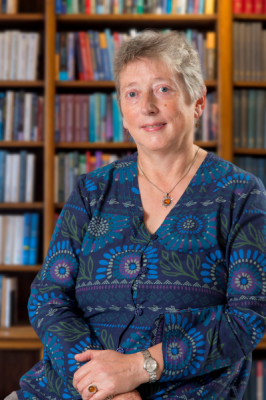 Reflecting on those early days, Professor Browning said that a lack of role models made it difficult for women to imagine reaching senior academic positions.
“As a woman, you didn’t really think you were going to become a professor because there were so few role models,” she said. “I was lucky to have very supportive male colleagues, but it was still difficult. Often, particularly in fusion research, I could be the only woman in the room.”
Her interest in astrophysics began in childhood, sparked by an early fascination with the moon and by watching the Apollo moon landings. While she initially pursued mathematics, that curiosity about space ultimately drew her back into astrophysics.
Over the course of her career, Professor Browning has built an international reputation in plasma physics. Her work has focused on understanding how hot, ionised gases behave and interact with magnetic fields - processes that underpin solar flares, space weather and the development of future fusion energy.
Her early research at 91ֱ²¥ helped pioneer the spherical tokamak, an innovative approach to magnetic confinement fusion. Philippa’s team at 91ֱ²¥ was among the first to develop this compact alternative to traditional ring‑shaped fusion devices, an approach that has since become central to international fusion research and now underpins the UK’s government‑backed STEP fusion energy programme.
Alongside her research, Professor Browning has been a committed teacher, supervising around 19 PhD students and teaching generations of undergraduates.
“I’ve always really enjoyed teaching,” she said. “The interaction with students, particularly in small groups, is something I’ll really miss.”
During her time at the University, Professor Browning witnessed significant institutional change, most notably the merger of UMIST and the Victoria University of Manchester. While the department grew from a small, close‑knit unit into a much larger one, she reflects that students themselves have remained much the same where their curiosity, ability and enthusiasm have always varied across a spectrum.
She has also played a significant role in University leadership and service, serving on Senate and the Board of Governors, and holding a range of departmental roles including postgraduate director and admissions tutor.
A long‑standing advocate for equality in science, Professor Browning has been heavily involved in national efforts to support women in physics. She served on the Institute of Physics’ Women in Physics and diversity committees, helping to deliver training, networking events and outreach activities in schools to improve visibility and role models for girls.
She balanced her academic career with raising her son and two step‑children at a time when childcare support was far more limited. She was involved in campaigning for and establishing the first UMIST nursery, with her son among the first children to attend.
Her achievements have been widely recognised. She is a recipient of the Royal Astronomical Society’s Chapman Medal for outstanding research in solar and space physics, and a Fellow of the Institute of Physics. As mentioned above, she is now due to receive the European Physical Society’s Hannes Alfvén Prize for plasma physics, a senior international award recognising her lifetime achievements in the field.
As she retires, Professor Browning will continue her research as Professor Emerita and remain active in public engagement, including talks and events at Jodrell Bank Observatory.
“Retirement feels emotional,” she said. “My identity has been so tied up with the University for so long. But I’m looking forward to having more time for music and walking and just seeing what comes next.”
Professor Browning’s department will mark her retirement with a special event, ‘Pipfest’, bringing together former colleagues and PhD students from across her career.