School of Social Sciences Research and Scholarship Showcase Highlights Teaching, Research and Real-World Impact
The School of Social Sciences Research and Scholarship Showcase highlighted innovative teaching, inclusive learning, and impactful research. Sessions explored AI and assessment, student partnership, public engagement, healthcare ethics, sustainability, and community collaboration, demonstrating how research and teaching can create meaningful change beyond the University.
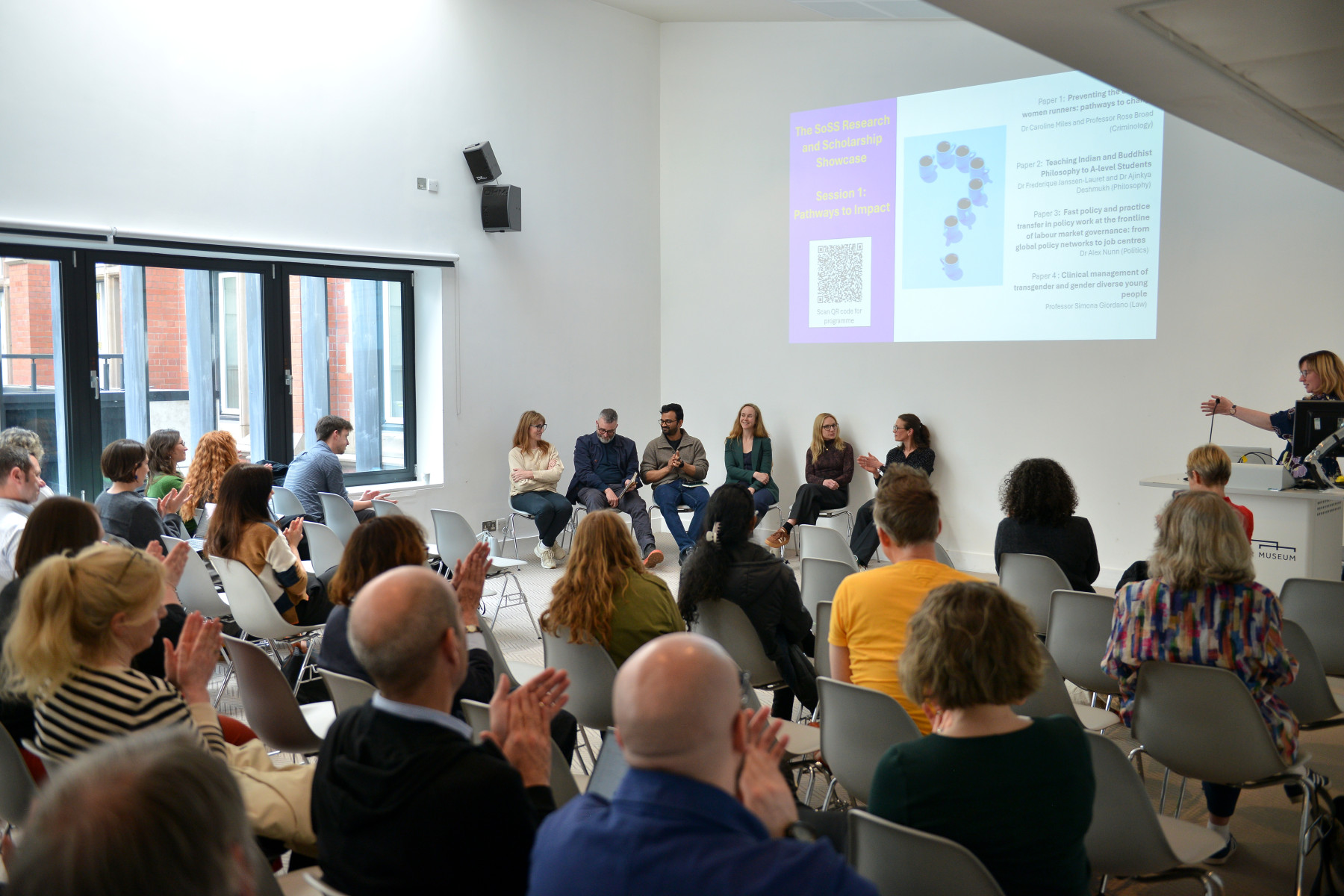
From oral exams in the age of AI to community-led research on public safety, healthcare, inclusion, and sustainability, the School of Social Sciences Research and Scholarship Showcase brought together academics, researchers, postdoctoral scholars, students, and external partners from across the School to highlight how teaching, research, and collaboration are shaping conversations far beyond the University.
The morning鈥檚 first session focused on inclusive and practice-based approaches to assessment. Dr Stephen Ingram discussed interdisciplinary group debates within the PPE programme, where students work across Philosophy, Politics, and Economics to tackle complex questions from multiple disciplinary perspectives, while also building a stronger sense of cohort identity and academic community.
Questions around assessment and emerging technologies continued in presentations from Dr Simon Rudkin who explored the use of generative AI within an MSc Data Science module. Students used tools including ChatGPT, Claude, Copilot, and DeepSeek to co-create research reports while critically reflecting on AI-generated outputs and workflows.
Dr William Floodgate then examined the growing use of oral exams within Criminology. Their presentation explored how scenario-based oral assessment can support critical thinking, communication skills, deeper engagement with learning, and academic integrity in the context of increasing AI use, while also acknowledging challenges around anxiety, scalability, workload, and accessibility.
Questions of participation, belonging, and student partnership continued in the showcase鈥檚 co-creation session. Dr Cristina Masters, Dr Aoileann N铆 Mhurch煤, Izzy Shah and Miza Fatahillah presented the Politics Inclusive Classrooms Project, a student-led initiative developed through years of staff鈥搒tudent collaboration around decolonising the curriculum, neurodiversity, inclusive assessment, and student voice.
Dr Tatjana Kecojevi膰, Dr Diego Perez Ruiz, Rishik Kalagara, Maan Mittal, Zhengyang Wu, Betty Lewis and Gavin Brady explored how student-led peer learning communities are helping widen access to data and digital skills through Data4All initiatives, mentoring, reproducibility workshops, GitHub portfolio development, and informal 鈥渄ata hangouts鈥�.
The afternoon research sessions turned to questions of impact, public engagement, and collaboration beyond academia. Dr Caroline Miles and Professor Rose Broad shared research on the abuse experienced by women runners, including fear, harassment, and the extensive safety work many women undertake while running.
Dr Frederique Janssen-Lauret and Dr Ajinkya Deshmukh discussed outreach work introducing Indian and Buddhist philosophy to secondary school pupils, while Dr Alex Nunn explored how research on labour market governance has informed policy development and evidence-based approaches to employment practice through collaboration with governments and international organisations.
Professor Simona Giordano examined ethical questions surrounding the clinical management of transgender and gender-diverse young people, reflecting on engagement with clinicians, advocacy groups, policymakers, and guideline development bodies around evidence standards, harm reduction, and healthcare ethics.
Collaboration also sat at the centre of the 鈥淚t Takes a Village鈥� panel, where researchers and external partners reflected on the opportunities and complexities of co-produced research. Cath Bowden discussed a multidisciplinary radiotherapy project developed with patients, clinicians, and public contributors to better understand treatment experiences and evidence in healthcare settings. Torik Holmes explored collaboration across the plastics recycling sector, while Katie Smith shared research with Chester Cathedral examining volunteering, belonging, and service through ethnographic work and public engagement.
Across the discussion, speakers reflected on how collaboration can produce richer and more grounded research, while also raising important questions around trust, shared ownership, institutional pressures, and meaningful involvement. External contributors including Tony Mulhall, Brian Turner, and Lisa Hamrang also highlighted the importance of integrating professional expertise, patient perspectives, and public-facing engagement into research processes.
The final session, 鈥淭hinking Outside the Box鈥�, explored how creative and participatory methods are reshaping research practice and public engagement. Dr Patty Doran discussed co-produced research on ageing in cities developed with older people, local authorities, and community organisations. Professor Hannah Knox presented the 鈥淭ravelling Power Station鈥�, a mobile exhibition and community energy project developed with grassroots energy groups.
Dr Chika Watanabe shared life-history research developed with a coastal community in Chile, including illustrated storytelling, intergenerational workshops, and documentary film exploring resilience and disaster experience. Professor Andreja Zevnik concluded with work addressing anti-Gypsyism through visual storytelling, including a competition featuring films, drawings, poetry, and creative submissions from young people, with the winning entry produced by Romani girls.
Across the day, a recurring theme emerged: research and teaching were most impactful when developed collaboratively 鈥� with students, communities, policymakers, clinicians, charities, and external partners helping shape not only outcomes, but the questions being asked in the first place. Together, the showcase reflected a School increasingly focused on inclusive learning, interdisciplinary thinking, creative practice, and research that connects directly with the communities and challenges beyond the University.