Researchers uncover history of giant east Himalayan glacier for the first time
Rise and fall of one of the lowest glaciers documented in High Mountain Asia is reconstructed using ultra-sensitive dating techniques
A giant glacier that once stretched for almost 100 kilometres through the eastern Himalayas retreated in a series of distinct stages over the last tens of thousands of years, research led by The University of Manchester has revealed.
The study was carried out in collaboration with the Australian Nuclear Science and Technology Organisation (ANSTO) and was made possible through the assistance of Emudu Trekkers and members of the Idu Mishmi community, the traditional custodians of the Dibang Valley. The research was funded by a Walters Kundert Fellowship from the Royal Geographical Society (UK).
This study provides the first dated glacial chronology for the Dri Valley in the remote eastern Himalayas, filling a major gap in understanding glacier evolution in one of the least-studied sectors of the Himalayas and providing an important benchmark for future studies of regional climate change.
Key findings
- The Dri Valley glacier reached almost 100 km in length, making it one of the largest glaciers yet documented in High Mountain Asia.
- It extended from altitudes of around 5,300 metres to as low as 1,300鈥�1,500 metres above sea level, giving it one of the lowest known glacier termini in High Mountain Asia.
- The glacier was 80 km in length around 19,600 years ago.
- By around 12,000 years ago, the glacier had retreated to altitudes above 3,250 m and was less than 20 km long.
- Today, its largest surviving remnant is less than 5 km long.
Reconstructing the past Himalayan landscape
Researchers examined the landscape of the Dri Valley for geomorphic evidence left behind by the ancient glacier, including U-shaped valleys, moraines and distinctive bedrock features created by the movement of ice.
The research combines detailed field observations with satellite mapping and digital elevation models to build a picture of the former ice extent and identify locations where exposed rock could provide evidence of past glacier movements.
These features provide a record of how the glacier shaped the landscape as it advanced and retreated, but establishing when those changes occurred required highly sensitive dating techniques.
鈥淭he Dri Valley preserves an exceptional record of past glaciation, but until now we had no reliable way of placing these landforms into a timeline,鈥� said Dr Shashank Nitundil of The University of Manchester, who led the research.
By linking the physical evidence preserved in the landscape with a detailed timeline, we have been able to reconstruct how a major Himalayan glacier evolved over tens of thousands of years.
Using rocks as natural clocks
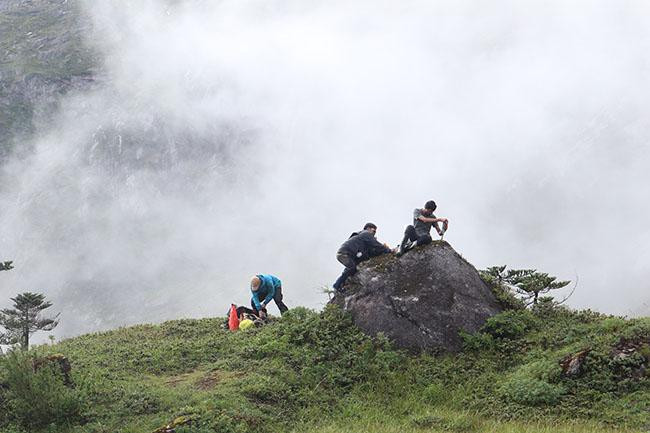
The researchers collected 63 samples from boulders and exposed bedrock surfaces across the Dri Valley. This is the first application of cosmogenic nuclide dating on the southern slopes of the Himalayas east of Mount Everest.
The samples were analysed for cosmogenic radionuclides 鈥� rare isotopes produced in rocks exposed at the Earth's surface by cosmic rays.
The team focused on beryllium-10 (10Be), which accumulates in quartz-bearing rocks while they are exposed to cosmic radiation. When a glacier covers a rock surface, production of the isotope is effectively halted and eventually reset due to glacial erosion. When the ice retreats and the rock is exposed again, 10Be begins to accumulate. Measuring its concentration allows researchers to determine when the ice disappeared.
The measurements were carried out using accelerator mass spectrometry at the Australian Nuclear Science and Technology Organisation (ANSTO), allowing the team to detect the extremely small quantities of 10Be needed to establish the timing of past glacier change.
鈥淭he huge size of the former glacier in the Dri Valley hints at similar extensive ice cover in neighbouring valleys and the presence of one of the largest contiguous ice masses in the Himalayas. Until now little has been known about the extent, timing and palaeoclimatic significance of the former glaciers in this region and the exciting results of this research have been made possible because of a major international collaboration between the University of Manchester, ANSTO and local support from members of the Idu Mishmi community鈥� said Professor Philip Hughes of The University of Manchester, who co-supervised the research and has had long-term collaborations with Dr David Fink at ANSTO.
Understanding monsoon-driven glacier change
The Dri Valley sits within a region dominated by the Indian Summer Monsoon, which delivers some of the highest precipitation across the Himalayas, making it an important natural laboratory for understanding how monsoon-fed glaciers respond to climate change.
The study shows that abundant monsoon precipitation alone was not enough to sustain this giant glacier. Instead, its growth and retreat were shaped by the interplay between temperature, precipitation and topography.
The findings suggest that once temperatures rise above a critical threshold, increasing precipitation falls as rain rather than snow. This reduces glacier accumulation and, at the same time, can accelerate ice loss through melting meaning heavy precipitation does not necessarily protect these glaciers from warming.
The study adds to growing evidence that the response of Himalayan glaciers to climate change is not uniform. Glaciers in different parts of the mountain range are influenced by contrasting combinations of snowfall, temperature, elevation and seasonal climate patterns.
As well as being climatically significant, the Dri Valley and surrounding region form part of a recognised Himalayan biodiversity hotspot, adding further importance to understanding how its glaciers and the water resources they feed are likely to change.
Understanding how Himalayan glaciers responded to past climate change provides an important long-term benchmark for improving projections of how these glaciers may respond to continued global warming in the future.
Publication details
The paper was published in journal Quaternary Science Reviews. The international research team included Dr Shashank Nitundil, Dr Christopher Darvill, Prof Abi Stone, Dr David Fink, Prof Philip Hughes, Dr Matt Tomkins and Dr Krista Simon.
DOI: