New framework aims to make digital evidence credible for medical device regulation
University of Manchester-led researchers have unveiled a roadmap for making computer-generated evidence trustworthy enough to help regulators decide whether medical devices are safe and effective, alongside laboratory and clinical evidence.
Published in the journal , the framework was developed by researchers from academia, industry and the Medicines and Healthcare products Regulatory Agency (MHRA), the UK鈥檚 regulator for medicines and medical devices. The work was carried out through the UK Centre of Excellence on In Silico Regulatory Science and Innovation (UK CEiRSI), which is funded by the MHRA, Innovate UK and the Medical Research Council.
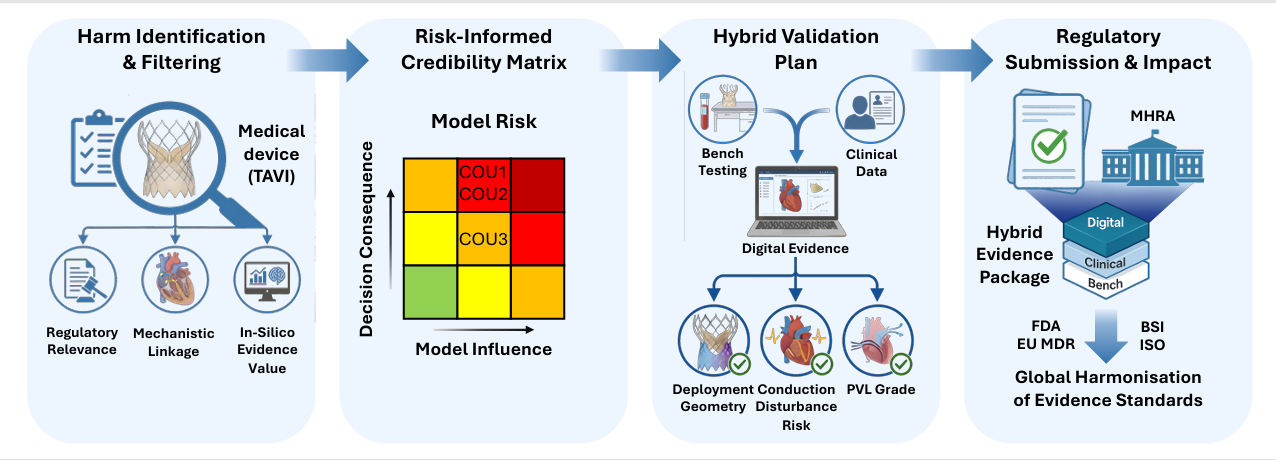
The framework sets out how computer simulations, known as in silico methods, can generate credible digital evidence for a specific regulatory decision: which questions they can appropriately inform, how much a decision relies on them, and what evidence is needed to establish their credibility.
Medical devices are currently tested using laboratory experiments, animal studies and clinical trials. Results from bench and animal studies do not always predict how a device will perform in people. Clinical trials, in turn, often under-represent groups such as women and ethnic minorities, so they may not fully reflect how a device performs in the wider patient population.
Yet these methods cannot remove all risk to patients or prevent costly failures. Published estimates suggest that only around 3 in 10 novel high-risk devices tested in people ever reach the US market. Even among those that make it to large pivotal trials, around 4 in 10 fail to gain approval. Some patient groups, such as pregnant women, are routinely excluded from clinical studies for ethical or practical reasons, while others, including children, are often under-represented.
Computer simulations could help fill some of these gaps, for example by testing how a device behaves in virtual patients: computer models based on real patient anatomy. The researchers stress, though, that they should complement rather than replace laboratory testing and human clinical evidence.
How can regulators have confidence that a computer model is credible for the specific regulatory decision it informs? International standards and guidance, including from the US Food and Drug Administration, already explain how to check whether a computer model is reliable and how to manage the risks of medical devices. But manufacturers still lack a clear, step-by-step route from a regulatory question to deciding which potential harms to model, what proof of the model鈥檚 reliability is needed, and how simulations should be combined with laboratory and clinical data.
This matters most when manufacturers change an existing device and need to work out what new evidence is required to show that the redesigned version is safe and works as intended.
The new framework bridges that gap. It filters potential harms using three questions: is the harm relevant to the regulatory decision; is there a plausible causal pathway linking the design change to the harm; and can simulation add evidence that complements or extends what bench tests and clinical studies already provide?
For each harm selected, it then asks how much the regulatory decision relies on the model, and how serious the consequences of a wrong decision would be. The answers determine how thoroughly the model must be checked: that it is built correctly, that it matches real-world measurements, and how certain its predictions are, including tests of how assumptions and natural variation, such as differences between patients, affect the results.
The researchers believe this risk-informed approach could help manufacturers generate credible digital evidence that complements traditional testing, and support efforts to help regulators in different countries accept the same evidence.
The framework was developed as part of UK CEiRSI鈥檚 In Silico Regulatory Airlock, where regulators, industry and academics jointly tackle real regulatory challenges. Working through a hypothetical redesign of a transcatheter aortic valve implantation (TAVI) device, the team reached a shared position on how such a submission could be assessed. TAVI replaces a diseased heart valve using a catheter, without open-heart surgery.
Although TAVI devices can save lives, the replacement valve must fit closely against the surrounding tissue while avoiding pressure on the heart鈥檚 electrical wiring, which can leave patients needing a pacemaker, and limiting leakage of blood around the valve.
In the exemplar, the framework considers three questions modelling could help answer: how the valve expands and sits in place, whether it disrupts the heart鈥檚 electrical signals, and whether blood leaks around its edge. It sets out how manufacturers and regulators can decide whether modelling is appropriate for each question, how reliable the model needs to be, and what checks should be carried out before its results are used to support a regulatory decision.
Professor Alejandro Frangi is the lead academic scientist and Executive Director of UK CEiRSI, which is headquartered at The University of Manchester.
He said: 鈥淢edical devices are becoming increasingly complex, but the tools used to evaluate them have not always kept pace with that complexity.
鈥淭hrough UK CEiRSI, we are working to provide a practical route for using advanced computer simulations in a way that regulators, manufacturers and clinicians can all trust.鈥�
First author Dr Yidan Xue, a BHF/UK CEiRSI Transition Fellow from the University of Manchester, said: 鈥淏y helping to establish when digital evidence is credible and how it should be assessed, our work shows how this could support safer innovation, help reduce development costs and improve access to new technologies for patients while maintaining the highest safety standards.鈥�
Co-author Mark Grumbridge, Head of Clinical Investigations at the MHRA, said:
鈥淟arger and more diverse virtual patient groups could ultimately reveal risks missed by conventional studies while reducing the number of people exposed to unproven medical devices.
鈥淔uture work will focus on expanding the use of large-scale virtual patient populations that better reflect the diversity seen in the real world.鈥�
Wil Woan, Executive Director of Heart Valve Voice, commented:
鈥淧atients want to know that the medical devices used to treat them are both safe and effective. Computer modelling offers an exciting opportunity to identify potential problems earlier and understand how devices might perform across a much wider range of patients. Used alongside clinical studies and real-world evidence, it could help us develop safer devices and bring important innovations to patients more efficiently.鈥�