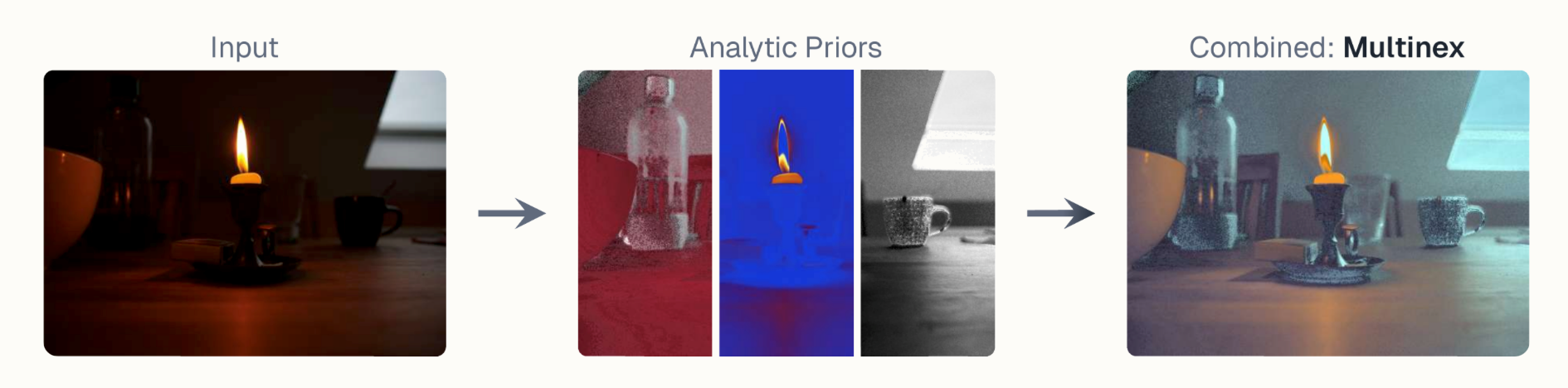
Multinex: An ultra lightweight AI model advancing low light image enhancement
A University of Manchester student has developed a powerful new ultra‑lightweight tool that can turn dark, noisy footage into clear, detailed and usable images.
, a new model for low‑light image enhancement (LLIE), was created by Computer Science undergraduate Alexandru Brateanu during his third-year project, working with academic supervisors.
The model outperforms comparable compact systems, recovering detail and clarity from images that would previously have been considered unusable.
The advancement has significant implications for photography, security, and a wide range of computational imaging tasks.
Low‑light image enhancement seeks to restore natural visibility, colour fidelity, and structural detail in scenes captured under poor illumination. While recent LLIE models have achieved impressive results, many rely on heavy architectures with large parameter counts, resulting in high computational cost and limited real‑time applicability. Efficiency has therefore become a central research challenge: how to enhance images more effectively while dramatically reducing model size.
In the work presented at the IEEE/CVF Conference on Computer Vision and Pattern Recognition 2026, the team proposes a structured solution grounded in classical colour vision theory and implemented using modern neural components within the Retinex framework. Retinex, a foundational approach in image enhancement, decomposes an image into illumination (light) and reflectance (colour) components to better handle low‑light scenes.
“My interest in low-light image enhancement began during a research internship after my first year of university, where I became increasingly focused on making visual AI both smaller and smarter. Multinex grew from the idea that better problem formulation can lead to more efficient models. By using classical colour and Retinex principles, together with multiple descriptions of light and colour, we help a compact network focus its limited capacity on the enhancement task itself, making it suitable for real-time AI in safety-critical visual systems.�
The design motivation behind Multinex is to extract as much useful information as possible from low‑light images using a highly compact architecture. By prioritising enhancement over reconstruction and leveraging lightweight neural operations, Multinex achieves strong illumination correction, detail recovery, and colour fidelity while using only a fraction of the parameters required by existing approaches.
The model is released in both a lightweight version (45K parameters) and an extremely compact nano version (0.7K parameters), each offering substantial reductions in computational load. Comparison to corresponding lightweight models such as PairLIE (330K parameters) and ZeroDCE (80K parameters) Multinex shows a significant performance improvement.
Like other LLIE techniques, Multinex still faces challenges in scenes with severe spectral distortions, lens flares, or mixed artificial and natural lighting. The team aims to extend the framework to these complex cases, exploring alternative formulations such as tone‑mapping or multiplicative residuals, and applying Multinex principles to related domains including intrinsic image decomposition, colour constancy, underwater enhancement, and haze removal.
The researchers demonstrate that Multinex delivers state‑of‑the‑art performance at real‑time cost, highlighting the power of combining analytic priors with modern lightweight design.
“Low-light image enhancement is essential to world modelling, the foundation of next-generation AI. It enables stable, predictive representations of real-world environments where standard visual assumptions fail. More broadly, this work highlights the importance of integrating classical knowledge of light, colour, and perception into modern AI systems—not replacing it, but extending it. Looking ahead, the ability to perceive and reason in the dark in an energy-efficient manner will be critical for future AI systems to achieve truly autonomous, real-world operation.�
Full title: Multinex: Lightweight Low-light Image Enhancement via Multi-prior Retinex
Presented at the IEEE/CVF Conference on Computer Vision and Pattern Recognition 2026
DOI: arXiv:2604.10359
URL: