Concrete waste from nuclear sites could help lock away radioactive strontium for the long term
Crushed concrete from legacy nuclear facilities could play a far greater role in safely managing radioactive land than previously understood.听
Research published in and conducted by scientists from The University of Manchester, United Kingdom National Nuclear Laboratory and Clemson University and funded by the Nuclear Decommissioning Authority, examined how crushed concrete interacts with strontium鈥�90, a mobile radioactive contaminant found at nuclear legacy sites such as Sellafield and Hanford.听
The team found that, under conditions similar to those expected in shallow, on鈥憇ite disposal environments, concrete can react and become a long鈥憈erm sink for strontium-90, particularly when exposed to air or treated with phosphate.听
鈥淥ur work shows that crushed concrete doesn鈥檛 just act as an inert waste material 鈥� it can actively remove strontium from solution and hold onto it in forms that are stable over long timescales. That鈥檚 important for understanding how lightly contaminated concrete could be applied on site to minimise radionuclide transport.鈥�
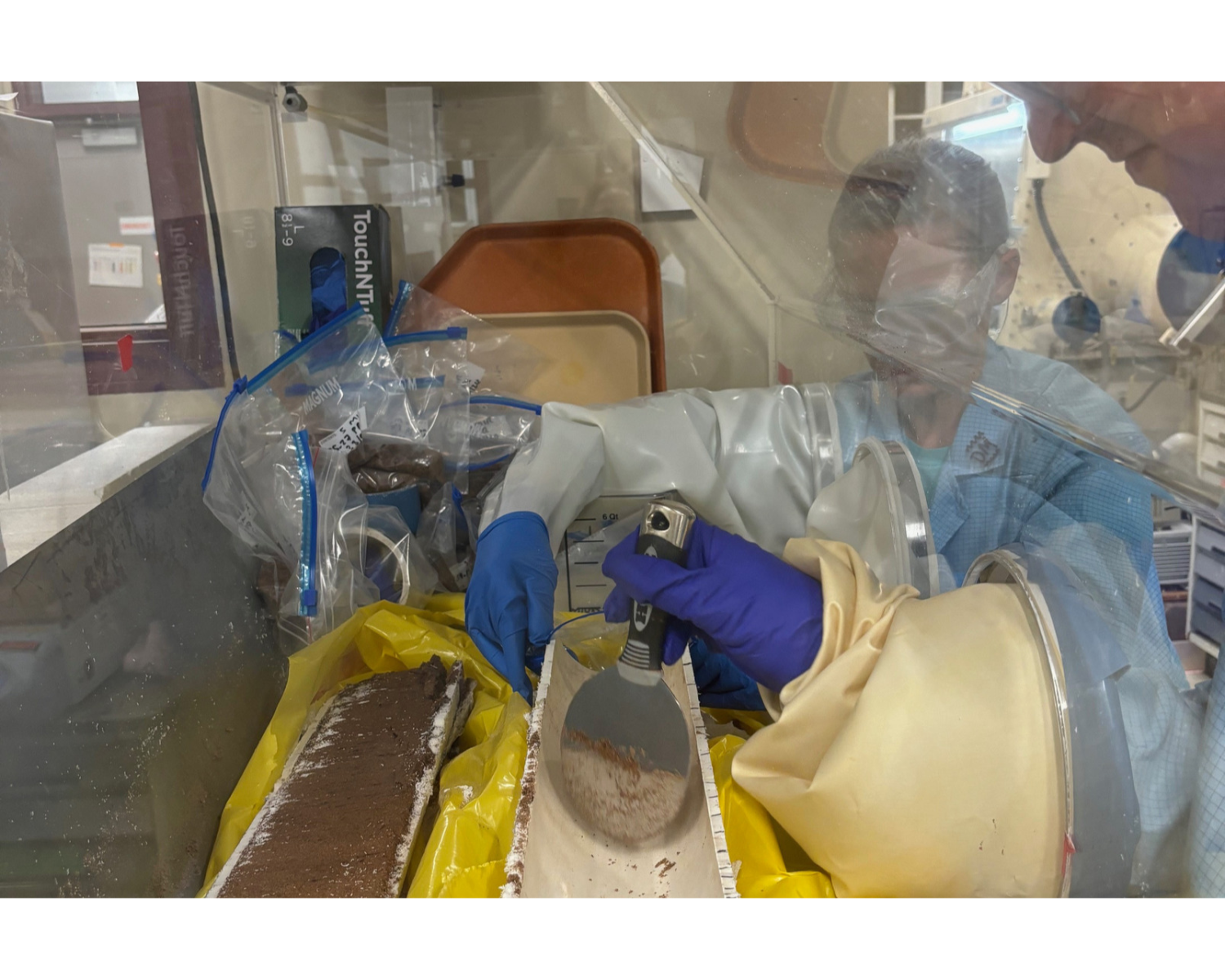
The research team used concrete sourced from the UK鈥檚 Nuclear Decommissioning Authority and tested how it behaved when mixed with synthetic groundwater containing either stable strontium or trace levels of radioactive strontium鈥�90. Experiments ran for three months under two contrasting conditions: air鈥憀imited, representing sealed or low鈥憃xygen (sub-surface) environments, and air鈥慹quilibrated (air-exposed), representing disposal scenarios where air is present.听
In air鈥慹quilibrated systems, the crushed concrete removed around 82% of strontium from solution within three months, compared with only 14% under air鈥憀imited conditions. This difference was linked to the formation of calcite, a calcium carbonate mineral that forms as concrete reacts with carbon dioxide in air. Strontium can substitute for calcium in calcite, locking it into the mineral structure.听
X鈥憆ay absorption spectroscopy confirmed that strontium was partially incorporated into newly formed calcite in these air鈥慹xposed systems, providing a mechanism for long鈥憈erm removal of strontium-90 from groundwaters.听
The team also tested two phosphate treatments 鈥� one where phosphate was added during the experiment, and one where the concrete was pre鈥憈reated with phosphate. Both approaches increased strontium uptake, even when air was limited.听
In air鈥慹quilibrated phosphate systems, up to 98% of strontium was removed from solution within 48 hours. Microscopy showed that poorly crystalline calcium phosphate coatings formed on the concrete surface, providing additional sites for strontium to sorb or incorporate over long timescales to allow radioactive decay to stable Zr.听
Strontium鈥�90 is a key contaminant at many historic nuclear sites because it is relatively mobile in groundwater. Significant volumes of lightly contaminated concrete are generated during decommissioning, and on鈥憇ite disposal is increasingly being explored to manage this material.听
The findings suggest that, when concrete is crushed and exposed to air 鈥� as would occur during recycling or shallow burial 鈥� natural carbonation processes can significantly enhance strontium retention. Phosphate treatments could further improve performance, particularly in areas where air access is limited.听
added: 鈥淭hese results give us a clearer picture of what happens when concrete waste interacts with groundwater over time. By understanding the mechanisms that trap strontium, we can better support safe, evidence鈥慴ased decisions about on鈥憇ite disposal and long鈥憈erm radioactively contaminated land management.鈥�
Journal: ACS ES&T Water
Full title: Strontium Interactions with Crushed Concrete Waste: Implications for Management of Radioactively Contaminated Land
DOI: 10.1021/acsestwater.6c00365
URL: