443-million-year-old fossils reveal early vertebrate eyes
Scientists analysing 443-million-year-old Scottish fossils have uncovered the early evidence that some of the first groups of vertebrates possessed surprisingly advanced eyes and traces of bone, reshaping our understanding of how the vertebrate body first evolved.
The study, led by The University of Manchester, offers a rare glimpse into a period of evolution that is usually extremely difficult to study because early vertebrates had soft bodies, so any remains are usually squashed, incomplete, or difficult to interpret.
Using a synchrotron particle accelerator, the Stanford Synchrotron Radiation Lightsource (SSRL) at SLAC National Accelerator Laboratory in California, USA, the researchers were able to map the chemistry within two tiny jawless fish called Jamoytius and Lasanius, found near Lesmahagow, south of Glasgow.
The findings, published today in , represent a huge advance in our understanding of the early stages in the development of the vertebrate lineage.
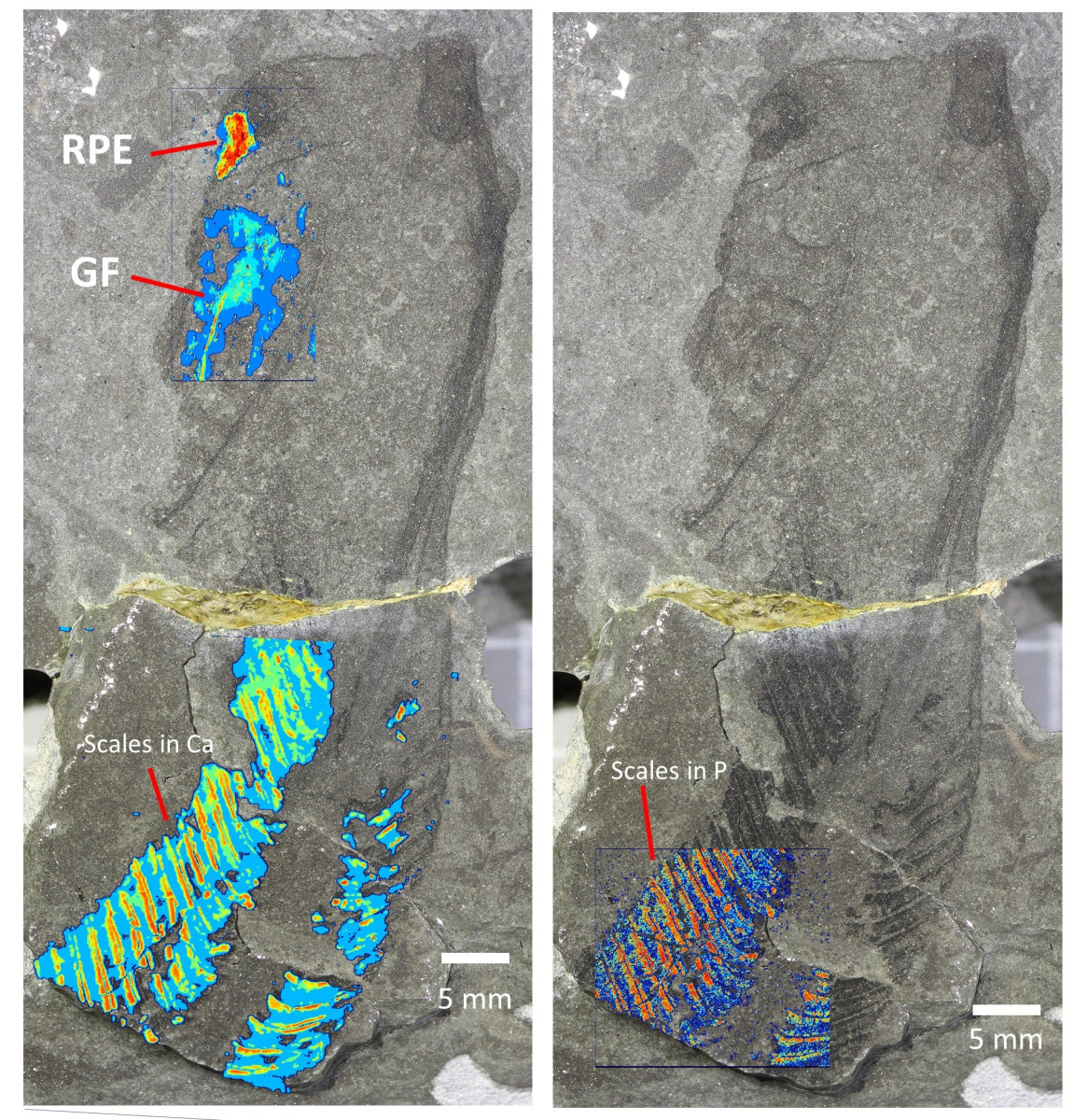
鈥淲e decided that transitional fossils, from one of the earliest stages of vertebrate evolution, would be perfect to look at with our new methods,鈥� explained researcher , Professor of Geochemistry at The University of Manchester. 鈥淲hat we were able to discover was far beyond our expectations. Not only did we identify early bone structures deep in the geological record, but we also captured the first-ever images of some of the oldest camera-type eyes. These eyes preserve even the small notch where the optic nerve connected - features that form the basis of modern vertebrate eyes today.鈥�
University of Manchester researcher , added: 鈥淚t鈥檚 been amazing to see just how much new information we can recover from fossils which are usually too poorly preserved to be useful using these new technologies. Our findings help resolve scientific debates that have been running since the Victorian era. They point to a very early origin of bones and eyes in vertebrate history, probably even predating the group appearing altogether.
鈥淚鈥檓 also excited because these fossils are most likely the ancestors of modern lamprey and hagfish, which now lack many of these features, so we鈥檙e adding to a growing body of work that shows those organisms have a far more complex evolutionary history than previously thought.鈥�
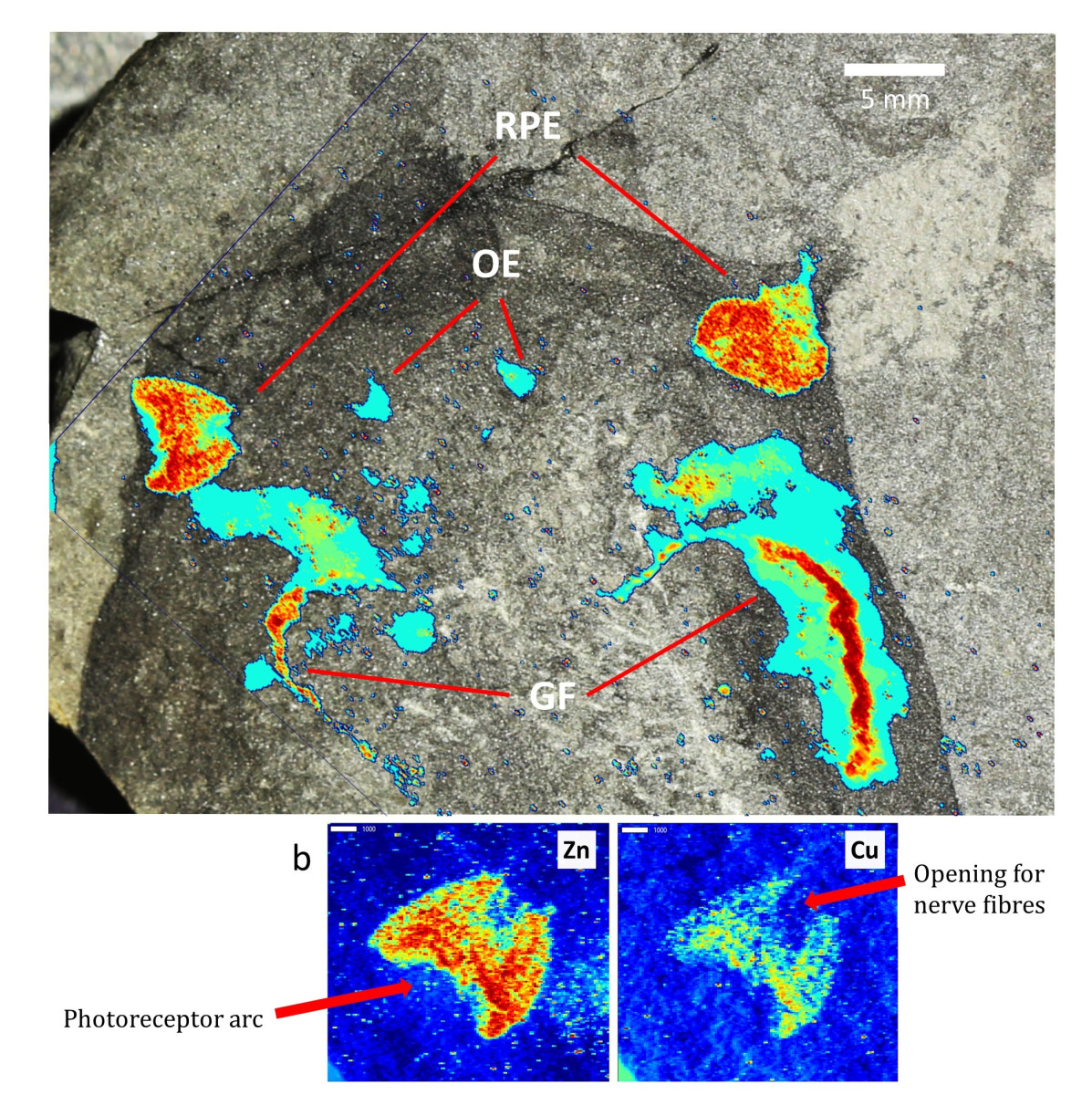
Synchrotron X-ray Fluorescence imaging works by scanning a sample in front of the intense X-ray beam generated by the synchrotron particle accelerator. The X-rays cause atoms in the sample to emit their own X-rays (X-ray fluorescence), which the scanning system detects. The properties of the fluoresced X-rays are specific to the chemical element they originated from. As such, this technique can be used to identify and map tiny differences in chemical elements locked inside fossils and in some cases, the chemical remnants of tissues no longer visible with visible light.
Dr Nick Edwards, a Staff Engineer for the X-ray Fluorescence Imaging beam lines at SSRL, performed the X-ray imaging experiments as part of a long-standing collaboration with The University of Manchester research team, with whom he worked with for his PhD studies.
He said: 鈥淪ynchrotron X-ray Fluorescence imaging is a versatile technique with advantages over other types of scientific analysis that make it amenable to studying fossils. The experiments do not need special environmental conditions, and we can place relatively large objects in the instrument without the need to remove material from them. We can detect the extremely low levels of elements present in biological systems and correlate them to specific fossil tissues in a matter of hours. The results from these fossils are fascinating and further corroborate that the chemistry of extinct organisms can be preserved over huge geological time scales and be useful in interpreting the evolution of life.鈥�
In this study, the team found traces of zinc and copper that revealed the structure of the retina and pigment layer in the ancient eyes. They also found calcium and phosphorus showing where early bone-like tissue was present.
The research has been praised internationally. Dr Pierre Gueriau of the University of Lausanne, who was not involved in the research, said: 鈥�This study not only rewrites some chapters of the evolutionary history of our early vertebrate ancestors, but also illustrates how advanced fossil imaging is not limited to CT scanning and encompasses a suite of analytical chemistry methods capable of revealing a new range of information, in some cases even considered lost to fossilisation. This is truly an exciting time to be a palaeontologist鈥�.
Corresponding author , a palaeobiologist at The University of Manchester, added: 鈥淚 love these fossil fish. They may have been dead for over 400 million years but they keep on surprising us with new hidden data about our deep origins.鈥�
The team will now continue using this high-energy physics technology to tease out the chemical remnants of early life in other vertebrates, providing key insights into the evolution of animals such as birds, dinosaurs, mammals, and even microbial life.
This paper was published in the journal Proceedings of the Royal Society B
Full title: Early vertebrate biomineralisation and eye structure determined by synchrotron X-ray analyses of Silurian jawless fish.
DOI: 10.1098/rspb.2025.2248
URL: